



What the latest Domain data means for property buyers and borrowers
The Australian housing market in 2026 has taken a sharp turn. The March quarter Domain House Price Report has confirmed that Sydney and Melbourne house prices have now fallen, ending months of renewed growth. Other capital cities continue to post strong gains, revealing a two-speed market that is dividing the country.
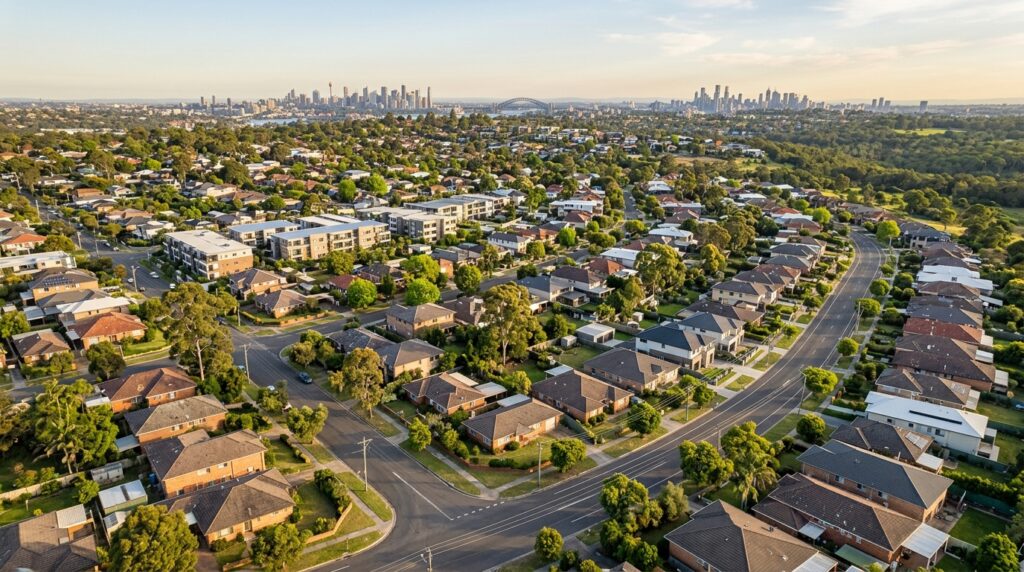
Housing market 2026
Sydney’s median house price dipped 0.04 per cent to $1,791,643, a fall of just $772, but the first decline since 2022. The previous quarter had seen a solid 2 per cent gain. Melbourne dropped further, with its median falling 0.6 per cent ($6,357) to $1,084,817. That figure is now below Melbourne’s December 2021 median.
Domain’s chief residential economist Dr Nicola Powell said the shift had happened quickly. She noted that buyers are now shaken and cautious, and that confidence has been knocked by rate rises, cost-of-living pressures, and global uncertainty from the ongoing Middle East conflict.
Agents on the ground report even sharper declines in the upgrader segment. Properties priced between $1 million and $2 million are seeing effective price drops of 3 to 7 per cent in Sydney and Melbourne.
What drove the fall
Three forces are hitting Sydney and Melbourne at once. Rising interest rates and their impact on borrowing power are a key factor, especially in cities where prices are already at their highest. Cost-of-living pressures, covering fuel, groceries, and insurance, are squeezing household budgets. And global uncertainty from the ongoing Middle East conflict is dampening consumer confidence.
Dr Powell noted that Sydney and Melbourne are simply more sensitive to rate rises than other markets. When rates climb, buyers in high-median cities face larger repayment increases. The result is that buyer activity slows first, and most sharply, in these two cities.
Buyer confidence readings have also fallen. Consumers are increasingly delaying purchase decisions rather than walking away entirely, which means demand has not disappeared but has been pushed out in time.
Other capitals surge
The picture is very different in other capital cities. Perth recorded the largest quarterly price increase, with the median rising $63,615 to a record $1,178,522. That is now nearly $100,000 above Melbourne’s median, and Perth’s annual growth sits at 24.6 per cent.
Adelaide gained $53,922 for the quarter, while Brisbane added just under $50,000, pushing its median to $1,212,195. That makes Brisbane Australia’s second most expensive capital city, behind only Sydney, with annual growth of 20.4 per cent.
Darwin led the annual growth table with a 19.7 per cent rise. The city’s median of $734,710 is the most affordable of any capital, and rental yields of 6 to 7 per cent have drawn strong investor interest from interstate.
Units vs houses
One consistent finding from the March 2026 quarter report is that units are outperforming houses in Sydney, Melbourne, Brisbane, and Perth. As house prices at the upper end face pressure, buyers are adjusting toward more accessible price points. Units offer a way into the market without the same level of exposure to the segments currently under the most stress.
For first home buyers or investors, this trend is worth watching. In the current environment, units are absorbing demand that would otherwise have moved into house markets, and that is supporting unit prices even as house prices soften in the major cities.
What it means for you
If you own property in Sydney or Melbourne, falling prices do not automatically mean your situation has worsened. Your home loan repayments depend on your rate and loan balance, not your property’s current market value.
If you are considering refinancing during a period of falling house prices, it is worth acting before any shift in equity changes what is available to you. Borrowers who built up equity over the past few years may still have strong refinancing options today.
If you are a buyer, a softer Sydney or Melbourne market creates more room to negotiate. Use a borrowing power calculator to understand exactly what you can borrow at current rates, then speak with a broker about how to position your offer.
Common questions
Q: Does a price fall in Sydney or Melbourne mean I should delay buying?
Not necessarily. Price movements are just one factor. Your personal financial position, interest rate environment, and long-term goals matter more than short-term market data. A slowdown can give you more negotiating power than you would have in a hot market.
Q: Why are Perth and Brisbane still rising while Sydney and Melbourne fall?
Affordability is the main driver. When interest rates rise, buyers in lower-priced markets feel less repayment pressure per dollar borrowed. Perth and Brisbane also have strong population growth and tight supply, which keeps demand elevated even when sentiment softens elsewhere.
Q: Should I wait for Sydney or Melbourne prices to fall further before buying?
Timing the market is very difficult. If prices fall another 2 per cent but interest rates rise again, you could end up with higher monthly repayments even on a lower purchase price. Focus on buying within your means rather than trying to pick the perfect entry point.