



How today's homes are being built to last generations
Sustainable homes in Australia are redefining what it means to build something that lasts. The country has long prized heritage properties, from Victorian terraces to Federation manors, for their ornate detail and connection to history. But experts say the homes built today will be judged not on decoration but on performance. Energy efficiency, climate resilience, and the use of durable materials are becoming the new markers of long-term property value in Australia.
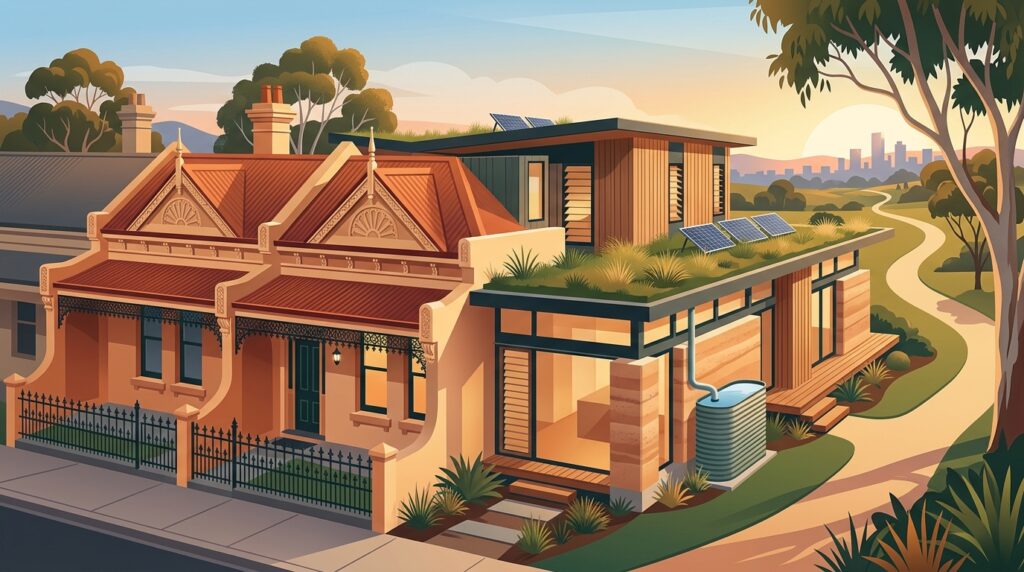
Future heritage
The word heritage once pointed firmly to the past. Federation verandahs, Edwardian leadlights, Art Deco curves. But that definition is shifting. Architects and developers working at the intersection of design and sustainability say tomorrow’s heritage homes will reflect the challenges of today: climate change, resource management, and the transition away from fossil fuels.
Liam Wallis, founder of boutique developer Hip V. Hype, says heritage is about how a building contributes to and enriches its neighbourhood. His Brunswick and Elwood townhouse projects were built fossil-fuel-free and designed to run on 100 per cent renewable energy. These passive-design homes maintain a steady internal temperature through all seasons, reducing the load on heating and cooling systems.
The aim, Wallis says, is for a building to look better in five to ten years than on the day it is finished. Robust materials, masonry and timber chosen because they age gracefully rather than wear down, are central to that philosophy.
Climate resilience
Climate resilience is moving up the priority list for Australian homeowners and buyers. Helen Oakey, chief executive of not-for-profit organisation Renew, says that in 50 years, homes will be judged on how well they prepared for the extremes of heat, bushfire, storm, and flood. Managing these impacts for safety and comfort will be a defining feature of valuable homes.
For buyers, this means looking beyond the aesthetic. A home that handles temperature extremes without high energy use is not just more comfortable. It is cheaper to run, and it may carry lower insurance risk in a climate-stressed environment. Look for good insulation, double-glazed windows, electric appliances, and solar power when you are inspecting properties.
Lasting materials
The choice of building materials has long-term financial implications that most buyers overlook. Architect Wesley Spencer of Wexhaus argues the construction industry is currently building the equivalent of fast-fashion architecture. Most homes built today may not survive past 2050. Buildings designed to last 100, 200, or 300 years require different materials and a different mindset from the outset.
Masonry and timber, when used well, patinate rather than deteriorate. They require less maintenance over time and tend to age in ways that add to rather than subtract from a property’s value. Before you start shortlisting properties, check your borrowing power so you know which price points are realistic for you.
Retrofit potential
Not every sustainable home starts from scratch. Retrofitting an existing property can significantly improve its performance and long-term value. A 1977 Melbourne home was recently transformed into a net-zero property through targeted upgrades: a rebuilt roof with added insulation, improved airtightness, double-glazed windows, and a switch from gas to electric appliances. The result is a home that is warm in winter, cool in summer, and far cheaper to run.
If you are looking at an older property with good bones, retrofit potential matters as much as its current condition. How easy would it be to add insulation? Is the roof suitable for solar panels? Are the windows single or double glazed? If you plan to use sustainable or non-standard materials in a build or renovation, it is worth understanding how lenders assess homes built with unconventional materials before you apply for finance.
Sustainable homes
When assessing sustainable homes in Australia, there are several practical things to look for. Start with the NatHERS energy rating, which scores homes on a 10-star scale. Higher-rated homes cost less to heat and cool, reducing ongoing living expenses and strengthening your capacity to service a home loan over time.
Also consider the block’s potential. Is there space for solar panels? Is the home oriented to capture winter sun? Are there provisions for battery storage or an electric vehicle charger? New modular and prefabricated eco-developments are proving that sustainable design does not mean compromising on quality. Use our loan repayment calculator to estimate what a sustainable property would cost you monthly before you make an offer.
Finance and value
Sustainable homes are increasingly factoring into lending decisions. Energy-efficient properties carry lower ongoing costs, and some lenders offer green home loan products with preferential rates for highly rated homes. This market is still developing in Australia but the direction is clear: sustainability and financial performance are becoming linked.
If you are building new, your choice of builder matters as much as the design itself. Know the signs that your builder may be in financial trouble before you sign any contract. Construction delays are especially costly when you are paying rent and a construction loan at the same time.
The long view is that sustainable homes are likely to hold their value better than energy-hungry properties. As grid costs rise, as climate risk becomes more apparent, and as the conversation about longevity in the built environment continues, the homes built today to last for centuries will be the ones future buyers compete hardest to secure.
Common questions
Q: Do sustainable homes cost more to buy?
Sustainable homes can carry a price premium, but the gap is narrowing as demand grows and eco-friendly construction becomes more common. The more useful comparison is lifetime cost. A higher purchase price combined with lower energy bills and reduced maintenance can work out less expensive over a 25 to 30-year loan term than buying a cheaper home that costs significantly more to run.
Q: Can I get a home loan for a net-zero or sustainable home?
Yes. Most lenders treat sustainable homes the same as any standard residential property. Some now offer green home loan products with small rate discounts for properties that achieve a high NatHERS star rating. Homes using unconventional materials like hemp or rammed earth may require specialist lenders. Speaking with a mortgage broker can help you identify the right fit for your situation.
Q: What is a NatHERS rating and why does it matter?
NatHERS stands for the Nationwide House Energy Rating Scheme. It rates a home’s thermal performance on a scale of 0 to 10 stars. New homes in Australia must meet a minimum 7-star rating. The higher the rating, the lower your heating and cooling costs, which reduces your living expenses and can improve your ability to service a home loan comfortably over time.